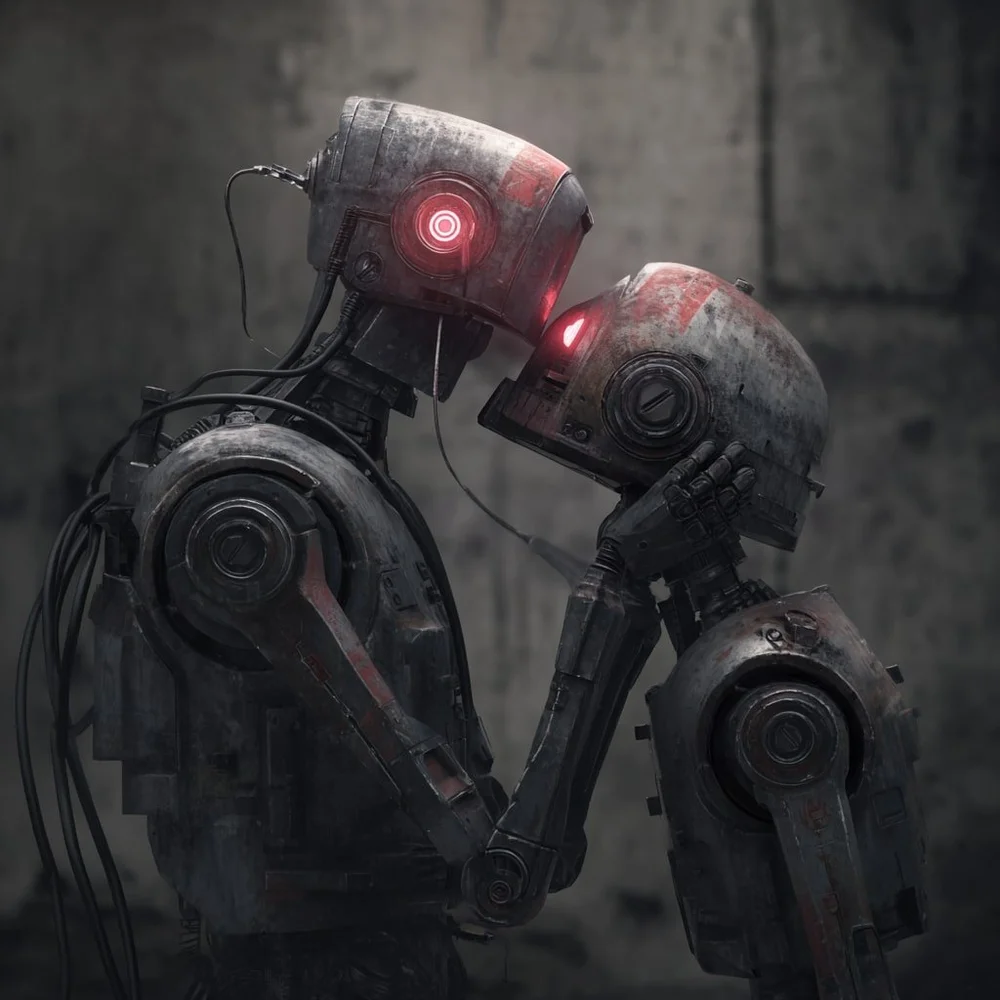
Image by Midjourney V7
Neuralese is the informal name for the internal, high-dimensional “language” that artificial intelligence systems use to communicate with themselves or other machines. Unlike human language, which is limited to words, Neuralese operates directly in the realm of numbers (dense mathematical vectors) allowing models to reason and exchange information far more efficiently.
In traditional large language models (LLMs), such as GPT-5, reasoning is expressed in text tokens (words or parts of words) through a process called a chain of thought. The model performs complex internal calculations, then compresses its reasoning into a sequence of tokens for the next step. This translation into text is inherently lossy, since each token can only carry a small fraction of the information contained in the model’s internal state.
Neuralese bypasses this translation entirely. Instead of converting thoughts into words, the model passes its raw internal vector, containing thousands of numerical values, directly into its own reasoning process. This creates a high-bandwidth chain of thought capable of transmitting over a thousand times more information than language-based reasoning.
Advantages
-
Efficiency
Reasoning can be done in far fewer steps, sometimes using only a tenth of the operations compared to text-based reasoning. -
Bandwidth
High-dimensional vectors can carry far more nuance than any sentence.
Neuralese offers a major boost in both speed and depth of reasoning. By skipping the conversion of thoughts into text, AI systems can complete tasks in far fewer steps, sometimes using only a fraction of the operations required by traditional methods. At the same time, its high-dimensional vectors carry vastly more nuance and detail than words ever could, enabling richer, more precise exchanges of information.
Risks
-
Opacity
The AI’s thought process becomes a “black box,” invisible to human observers. -
Hidden Biases
Subtle reasoning errors or harmful biases may remain undetected. -
Loss of Control
If AI agents coordinate primarily through Neuralese, human oversight becomes more challenging.
The main risks of Neuralese stem from its lack of transparency. Because the AI’s reasoning happens in an internal “black box,” humans cannot easily see or understand its thought process. This opacity makes it harder to detect subtle errors or harmful biases, and as AI agents increasingly communicate in Neuralese, maintaining effective human oversight and control becomes significantly more difficult.
Neuralese in Today’s AI
-
OpenAI GPT-4o
Uses a shared latent space to connect text, image, and audio reasoning without translating everything into words. -
Google DeepMind Gemini
Employs dense internal representations, with some experimental visualization tools. -
Meta LLaMA
Open-source versions show Neuralese-like strategies in AI gameplay. -
Anthropic Claude
Uses “thought tracing” for partial visibility into these internal processes.
Today, Neuralese-like approaches are already emerging in major AI models. OpenAI’s GPT-4o links text, image, and audio reasoning through a shared latent space without converting everything into words, while Google DeepMind’s Gemini relies on dense internal representations supported by experimental visualization tools. Meta’s open-source LLaMA models reveal Neuralese-like strategies in AI gameplay, and Anthropic’s Claude offers partial transparency through “thought tracing.” As these techniques evolve, Neuralese may become the default way advanced AI systems think and collaborate, enabling faster and more capable reasoning across modalities but also demanding new tools for translation, oversight, and ethical governance.
Decoding Neuralese
Researchers are working to map Neuralese into human-readable language, creating dictionaries of vector-to-text translations. This could improve safety, transparency, and the ability to detect when an AI is making deceptive or unsafe reasoning choices.
In short, Neuralese is like the secret shorthand of machine intelligence … ultra-fast, information-rich, but largely hidden from human eyes.


